
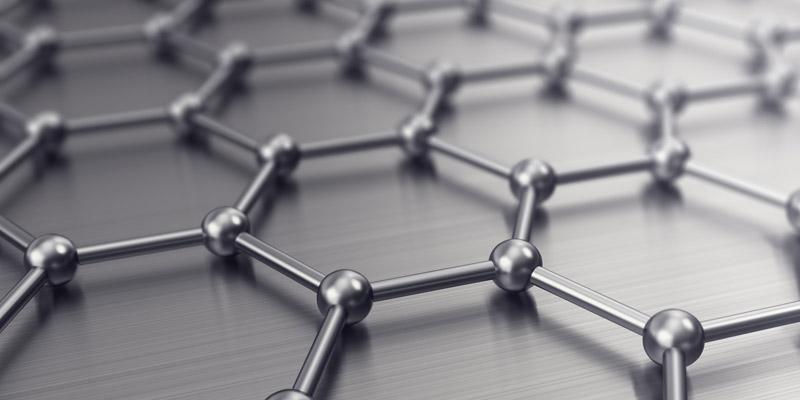
What is graphene?
In school you probably learned that carbon comes in two basic but startlingly different forms (or allotropes), namely graphite (the soft, black stuff in pencil “leads”) and diamond (the super-hard, sparkly crystals in jewelry). The amazing thing is that both these radically different materials are made of identical carbon atoms. So why is graphite different to diamond? The atoms inside the two materials are arranged in different ways, and this is what gives the two allotropes their completely different properties: graphite is black, dull, and relatively soft (soft and hard pencils mix graphite with other materials to make darker or fainter lines); diamond is transparent and the hardest natural material so far discovered.
If that’s what you learned in school, you probably finished your studies quite a while ago, because in the last few years scientists have discovered various other carbon allotropes with even more interesting properties. There are fullerenes (discovered in 1985; hollow cages of carbon atoms, including the so-called Buckyball, Buckminsterfullerene, made from a kind of football-shaped cage of 60 carbon atoms), nanotubes (discovered in 1991; flat sheets of carbon atoms curled into amazingly thin, hollow tubes one nanometer in diameter)—and (drum roll) graphene (discovered in 2004).
So what exactly is graphene? Peer inside lots of familiar solid materials (including most metals) and you’ll find what’s known as a crystal lattice (another name for a solid’s internal, crystalline structure): lots of atoms arranged in a regular, endlessly repeating, three-dimensional structure a bit like an atomic climbing frame, only instead of bars there are invisible bonds between the atoms that hold them together. Diamond and graphite both have a three-dimensional structure, though it’s completely different: in diamond, the atoms are tightly bonded in three-dimensional tetrahedrons, whereas in graphite, atoms are bonded tightly in two-dimensional layers, which are held to the layers above and below by relatively weak forces.

General properties
Graphene is an amazingly pure substance, thanks largely to its simple, orderly structure based on tight, regular, atomic bonding, Carbon is a nonmetal, so you might expect graphene to be one too. In fact, it behaves much more like a metal (though the way it conducts electricity is very different), and that’s led some scientists to describe it as a semimetal or a semiconductor (a material mid-way between a conductor and an insulator, such as silicon and germanium). Even so, it’s as well to remember that graphene is extraordinary—and quite possibly unique.
Strength and stiffness
If you’ve ever scribbled with a soft pencil (something like a 4B), you’ll know that graphite is horribly soft. That’s because the carbon layers inside a stick of graphite shave off very easily. But the atoms within those layers are very tightly bonded so, like carbon nanotubes (and unlike graphite), graphene is super-strong—even stronger than diamond! Graphene is believed to be the strongest material yet discovered, some 200 times stronger than steel. Remarkably, it’s both stiff and elastic (like rubber), so you can stretch it by an amazing amount (20-25 percent of its original length) without it breaking. That’s because the flat planes of carbon atoms in graphene can flex relatively easily without the atoms breaking apart.
No-one knows quite what to do with graphene’s super-strong properties, but one likely possibility is mixing it with other materials (such as plastics) to make composites that are stronger and tougher, but also thinner and lighter, than any materials we have now. Imagine an energy-saving car with super-strong, super-thin, super-light plastic body panels reinforced with graphene; that’s the kind of object we might envisage appearing in a future turned upside down by this amazing material!
Thinness and lightness
Something that’s only one atom thick is bound to be pretty light. Apparently, you could cover a football field with a sheet of graphene weighing less than a gram—although it’s pretty unlikely anyone has actually tried! According to my quick calculations, that means if you could cover the entire United States with graphene, you’d only need a mass of around 1500–2000 tons. That might sound a lot, but it’s only about as much as about 1500 cars—and it’s completely covering one of the world’s biggest countries!
Heat conductivity
As if super strength and featherweight lightness aren’t enough, graphene is better at carrying heat (it has very high thermal conductivity) than any other material—better by far than brilliant heat conductors such as silver and copper, and much better than either graphite or diamond. Again, we’re most likely to discover the benefit of that by using graphenes in composite materials, where we could use them to add extra heat-resistance or conductivity to plastics or other materials.
Electrical conductivity
This is where graphene starts to get really interesting! Materials that conduct heat very well also conduct electricity well, because both processes transport energy using electrons. The flat, hexagonal lattice of graphene offers relatively little resistance to electrons, which zip through it quickly and easily, carrying electricity better than even superb conductors such as copper and almost as well assuperconductors (unlike superconductors, which need to be cooled to low temperatures, graphene’s remarkable conductivity works even at room temperature). Scientifically speaking, we could say that the electrons in graphene have a longer mean free path than they have in any other material (in other words, they can go further without crashing into things or otherwise being interrupted, which is what causes electrical resistance). What use is this? Imagine a strong, light, relatively inexpensive material that can conduct electricity with greatly reduced energy losses: on a large scale, it could revolutionize electricity production and distribution from power plants; on a much smaller scale, it might spawn portable gadgets (such as cellphones) with much longer battery life.

 SCIENCE AND TECHNOLOGY